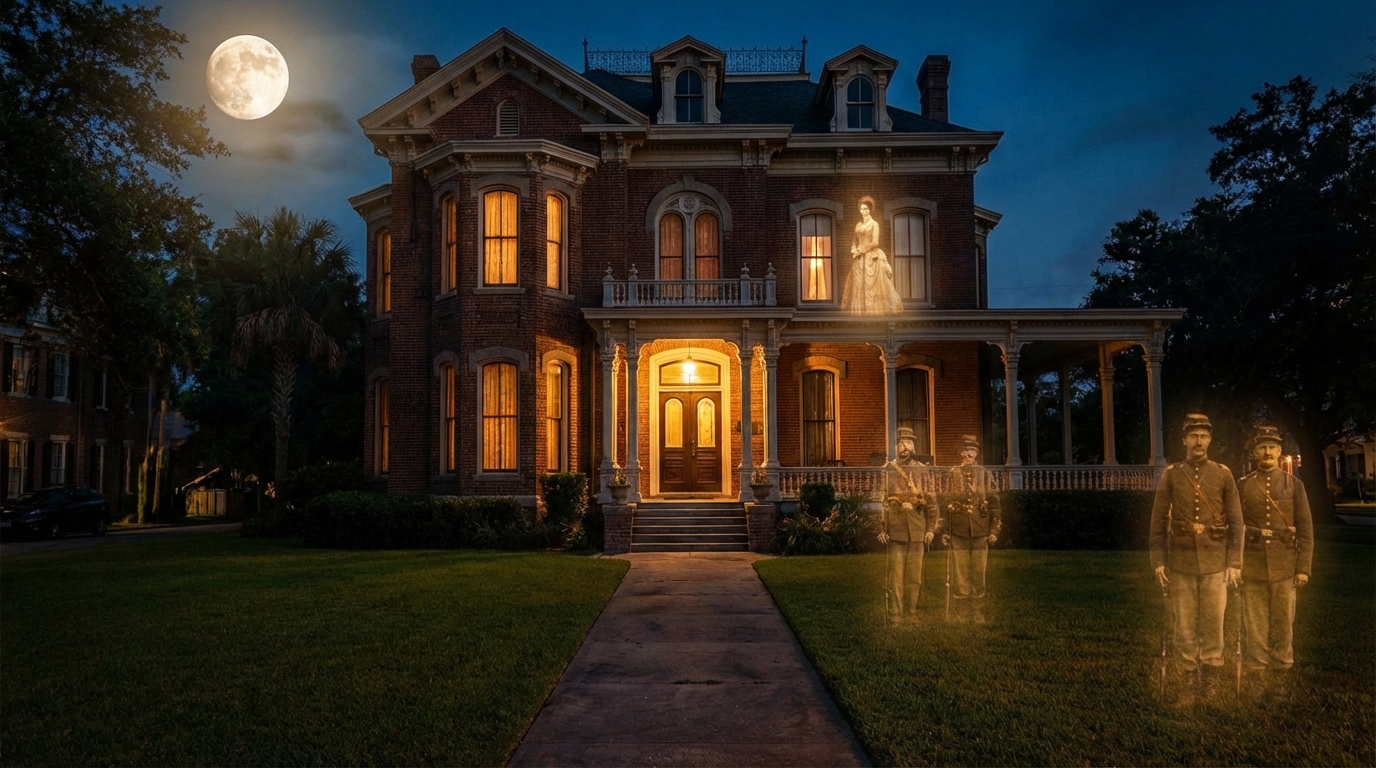
Ashton Villa is one of the most persistently haunted properties in Texas — a 16,500-square-foot Italianate mansion where three generations of the Brown family lived, loved, suffered, and died between 1859 and 1926. The ghost of Miss Bettie Brown, the cigar-smoking, globe-trotting “Texas Princess” who never married and never left, has been spotted by tour guides, caretakers, and visitors in her signature turquoise gown, standing at the top of the grand staircase or gazing out the Gold Room windows. Piano music drifts from empty rooms after dark. Alarms trip on Bettie’s birthday. A locked chest of drawers opens itself when no key has existed for decades. Confederate soldiers march through the halls of a house that served as a military hospital, headquarters for both armies, and shelter during the deadliest natural disaster in American history.
A Self-Made Tycoon Builds Broadway’s First Mansion
James Moreau Brown was a runaway teenager from Orange County, New York, who landed in Galveston in 1843 during the final days of the Texas Republic. He arrived with nothing. By 1859, his brick mason’s apprenticeship had made him a builder, then a hardware magnate — owner of the largest hardware store west of the Mississippi — then a railroad president, banker, and the fifth-wealthiest man in Texas.
On January 7, 1859, Brown paid $4,000 for four lots at the corner of Broadway Boulevard and 24th Street. He designed the house himself using enslaved labor, including a skilled brick mason named Alek whom Brown purchased specifically for his craftsmanship. The walls rose 13 inches thick. Ornate cast-iron verandas were imported from an East Coast foundry. Gas chandeliers illuminated 14-foot ceilings. Two indoor bathrooms — revolutionary for the era — were installed. The family hosted their first New Year’s Day party on January 1, 1860.
Brown’s wife, Rebecca Ashton Stoddart, named the estate Ashton Villa after her ancestor Lieutenant Isaac Ashton, a Revolutionary War hero. The house was Galveston’s first brick mansion and set the architectural standard for the grand homes that followed.
War, Suffering, and Death Behind the Golden Walls
When the Civil War erupted in 1861, the mansion became Confederate Army headquarters in Galveston. Wounded soldiers were treated in makeshift hospital wards as Rebecca Brown nursed them. Young Bettie, just six years old, watched it all. In fall 1862, the Union Army captured Galveston and briefly commandeered Ashton Villa as their own headquarters — before Confederate forces recaptured the city on January 1, 1863.
Three members of the Brown family died inside Ashton Villa. James Moreau Brown passed away on Christmas Eve 1895, age 74. His widow Rebecca died in October 1907. Their eldest daughter Bettie died on September 13, 1920, at age 65, after what biographer Sherrie McLeRoy identified as likely ALS (Lou Gehrig’s disease) — a slow, agonizing decline in the very rooms where she had lived since childhood.
The 1900 Galveston Hurricane, the deadliest natural disaster in American history with 6,000 to 12,000 dead, tested the mansion’s survival. Floodwaters surged to the 10th step of the grand staircase. The family opened the ground-floor doors and windows to let the floodwater flow through rather than build up catastrophic pressure — saving the house. Afterward, Bettie drove through the shattered city, then opened Ashton Villa as a shelter for the homeless and organized food distribution and orphan relief.
The Texas Princess Who Never Left
Bettie Brown is one of the most fascinating women in Texas history. Born February 18, 1855, in Ashton Villa itself, she grew into a tall, striking blonde known as “The Texas Princess.” She studied painting in Vienna under the Royal Court painter, rode camels to the Egyptian pyramids, attended a garden party hosted by Emperor Franz Joseph, and maintained apartments in New York City and London. She traveled alone — to Japan, India, Jerusalem, Morocco, China, South America, and Greece — at a time when women rarely left home without chaperones.
Bettie’s eccentricities scandalized Victorian Galveston. She smoked cigars in public, drank openly at her own parties, raced carriages down Broadway, and rolled a red carpet from the front door to the street for her legendary New Year’s Eve balls. She advocated for women’s suffrage and organized a controversial “Tango Ball” in 1913 that the Galveston Ministerial Association denounced as harmful to public morals. She had many suitors but never married.
Her younger sister Matilda “Tilly” Brown lived a darker story. Tilly’s marriage to Thomas Sweeney turned violently abusive. On February 1, 1896, Thomas threatened Tilly with a butcher knife. Three days later, she fled to Ashton Villa with her children and never left. During the divorce — extraordinary for a Victorian woman — Thomas’s lawyer accused Bettie of exercising “hypnotic powers” over her sister. Bettie’s retort was devastating: “If I had ever possessed any hypnotic power I should have used it on Mr. Sweeney to make him a good husband to my sister whom I idolized.” Tilly won custody and full property rights.
Thomas Sweeney later died at the Tremont Hotel under circumstances that sparked whispered rumors about Tilly’s involvement — though the coroner’s report listed natural causes. Some say his angry ghost still wanders Galveston, unable to find peace.
Where the Ghosts Walk: Room-by-Room Hauntings
The Gold Room is the epicenter. Staff and visitors have seen the full-body apparition of Bettie Brown standing near the windows, gazing toward the Gulf. In the 1920s, a groundskeeper told the Galveston Daily News he saw “a woman in a turquoise gown — Bettie’s favorite color — standing by the Gold Room window,” who vanished when he called out. Piano music is heard after hours, though Bettie never learned piano — the phantom pianist is likely Tilly, who played both piano and violin. A night caretaker identified only as “Mr. T.” once heard piano music from the Gold Room and saw “the faint image of a woman in 19th-century attire” seated at the piano. The air was heavy with jasmine — Bettie’s signature perfume. Furniture in the Gold Room reportedly moves by itself, and clocks stop at odd hours for no mechanical reason.
On February 18, 1991 — Miss Bettie’s birthday — the mansion’s alarm system went off without cause, and a ceiling fan that had been turned off was found running the next morning. As if the spirit were announcing her presence on her own anniversary.
Visitors have reported hearing the disembodied voice of a man arguing with an unseen woman — some speculate this is Thomas Sweeney, Tilly’s abusive ex-husband, still pleading his case from beyond the grave. Others suggest it may be one of Bettie’s many rejected suitors.
The grand staircase and second-floor landing are the most visually dramatic haunting sites. A tour guide reported seeing “a beautiful golden-haired woman in a turquoise evening gown, holding an ornate fan, standing on the second-floor landing.” A 1980s tour group collectively witnessed a blonde woman on the landing holding one of Bettie’s ostrich feather fans, who disappeared when approached. Phantom footsteps echo on the staircase regularly.
Bettie’s day room produces interactive phenomena. Her Middle Eastern chest of drawers is found sometimes locked, sometimes unlocked — despite the key being lost for decades. One bed “refuses to stay made.” Guests have reported feeling “a cold hand brush their arm” in the hallway.
The grounds host Civil War-era soldiers — phantom figures marching through the property where wounded Confederates were once treated.
Ashton Villa offers ghost tour storytelling material that is rare in its richness: verified history of death inside its walls, a cast of unforgettable characters — the self-made tycoon, the cigar-smoking feminist who died of a wasting disease in her childhood bedroom, the battered sister who fled there for safety, the wounded Confederate soldiers — and a continuous record of paranormal reports spanning more than a century. Bettie Brown spent 61 of her 65 years inside these walls. The evidence suggests she may still be there, playing piano music she never learned in life, locking chests with keys that no longer exist, and making sure everyone knows this is still her home.