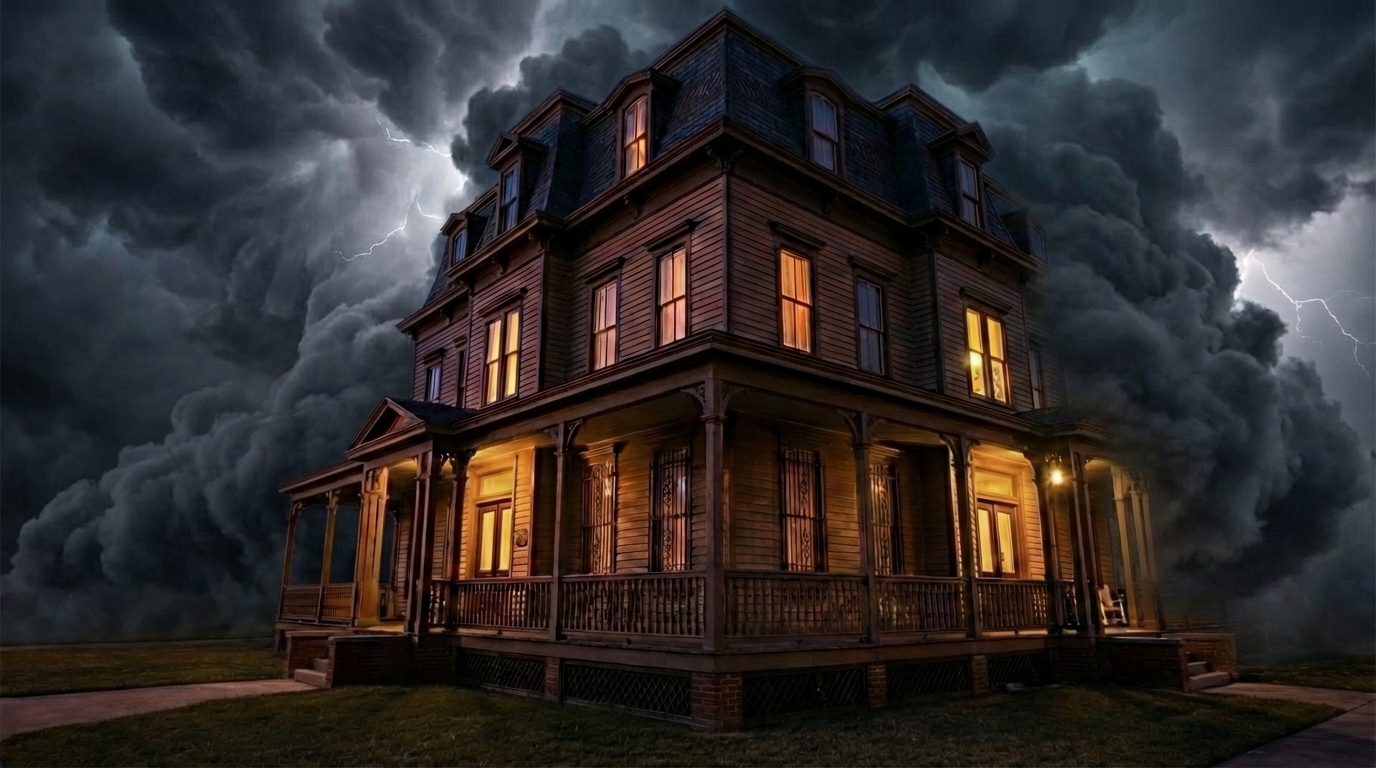
The former Normandy Inn at 1101 23rd Street is arguably Galveston’s most infamous haunted address — a three-story boarding house built in 1912 that has been called “a portal to hell.” The building spent roughly 15 years abandoned and deteriorating after 2007, breeding some of the island’s wildest paranormal legends: a possessed child leaping from a third-story window, Satanic altars discovered by police, an Egyptian mummy buried on the grounds, and demonic entities that have allegedly plagued the structure since the day it was built. Now beautifully restored and operating as The Mansard House boutique hotel since 2024, the property sits at a fascinating crossroads where documented history, embellished folklore, and genuine unexplained encounters all converge.
A Boarding House Born in the Shadow of Catastrophe
The building has no direct connection to the Great Storm of 1900 — it was built 12 to 13 years after the deadliest natural disaster in American history — but its story is inseparable from the island’s traumatic past. George C. Smith, a telephone operator at the Galveston Daily News, and his wife Louise Dowling Smith designed and constructed the boarding house in 1912–1913 on four lots at the corner of 23rd Street and Avenue K, in the “Silk Stocking” neighborhood of the East End Historic District. The building opened on February 1, 1913, advertising in the local paper as a “strictly modern” establishment with amenities that were luxurious for the era: hot and cold running water, private bathtubs, electric call bells, speaking tubes, and ice water faucets on every floor.
The original design packed 27 rooms across three stories and over 7,700 square feet: 20 rooms for rent, four bathrooms, three porches, six hallways, 27 closets, two brick fireplaces, and a ground-floor kitchen and dining room. Its most distinctive architectural feature — a mansard roof incorporating the entire third story with dormer windows — would eventually give the building its current name. Early boarders included clerks, bookkeepers, butchers, and druggists, and a 1920 census shows 20 people living there as boarders.
The Smith family’s own story carried its share of tragedy. George and Louise divorced in 1915. Louise’s son from a previous marriage, Louis Holmes, served in the Marine Corps during World War I and was shot multiple times in the legs at the Battle of Chateau-Thierry in June 1918. His mother received a telegram reporting him dead — only to later receive letters from him, then finally learn he was alive and recovering in a Paris military hospital. Louise’s daughter, Louise Faye, married Edward O’Brien in 1918 but died during a visit to San Antonio in May 1925. Her funeral and visitation were held at the boarding house itself — the first documented death directly connected to the property.
Five Owners, a Convicted Killer, and a Slow Descent into Darkness
The building passed through a succession of owners, several of whom met untimely ends — a pattern some have called a “curse.” In 1926, Jessie Belle Cather Perry purchased the house and all its furniture. Perry was a widow whose husband had died during the 1919 Spanish Flu epidemic. She initially renamed the establishment “The Paramount,” but locals quickly took to calling it “Perry’s Place.” She ran the boarding house for 25 years with her sons and her sister Ella Cather until her death in 1951. Her sister had died just one year earlier. Perry remains the longest-serving operator in the building’s history.
After lingering as a boarding house through the early 1970s and briefly serving as an antique store, the property was purchased around 1996 by Norman Jones, who renovated the interior, filled it with antiques, applied for a bed-and-breakfast permit, and christened it “the Normandy Inn.” Jones listed the property for sale before ever fully opening it to guests. In a darkly ironic twist, Robert Durst — the real estate heir later convicted of murder and the subject of HBO’s The Jinx — along with his wife Deborah Charatan, expressed interest in purchasing the Normandy Inn for personal use just before Durst’s 2003 acquittal in the Morris Black murder trial in Galveston. The sale never went through. Jones died in 2004 at age 57. His family completed the refurbishment by 2005.
In September 2007, investment partners George Wood and Matthew D. Wiggins (a former mayor of Kemah) purchased the property — then sold every piece of furniture and every antique inside it within a single month. The two became embroiled in legal disputes, and the building was left to rot. For roughly 15 years, the Normandy Inn sat abandoned, its windows boarded, its rooms open to trespassers and squatters. It was during this long period of dereliction that the property’s paranormal reputation exploded.
The Ghost Stories: What the Record Shows
The Normandy Inn’s haunted legends range from the genuinely eerie to the wildly embellished. Understanding which stories have documented roots — and which appear to have grown organically from years of abandonment and trespassing — makes the telling all the more compelling.
The boy who jumped from the window is the property’s most famous ghost story, and it exists in multiple versions. The tale describes how, on the day of a housewarming party shortly after construction, the Smiths’ young son “George Jr.” began behaving violently and saying malicious things. While the nanny was reporting this to his parents, the six-year-old allegedly leaped from a third-story window, survived with broken bones, and told his father: “I’m sorry, Dad. But they wanted me to kill everybody in the house.” Alternative versions have the boy saying, “Something evil was going to kill me.” The story gains extra power from a reported echo event years later, when a teenage trespasser went to the third floor alone and jumped — allegedly waking from a coma with no memory of being in the building. However, historian Kathleen Maca’s thoroughly researched article in Galveston Monthly traces this tale to a much more mundane origin: a group of teenage trespassers about 20 years ago dared one of their group to jump from the window. No contemporary newspaper accounts of a child jumping from the building in the 1910s have ever been found.
The earliest documented paranormal claims come not from the building’s construction but from a Halloween article in the Galveston Daily News on October 31, 1989, by journalist Sonya Garza. The article was later cited in Docia Schultz Williams’ 1996 book Ghosts Along the Texas Coast. A then-resident named Mrs. Stanford and her married daughter Linda Groh reported genuinely unsettling experiences: unexplained footsteps, eerie laughter, nightmarish visions, and — most specifically — tapping from the floor above every night at midnight for an entire summer, described as sounding like people tap dancing. Groh also heard distant laughter and faint music when she was alone in the house. The third floor, she said, “always gave her the creeps.”
A medium was brought in and identified two spirits — one male, one female — who were “emotionally attached” to Stanford. The medium’s verdict was memorable: Stanford would have to leave to get rid of them. Stanford’s response: “The medium told me in order to get rid of the spirits, I’d have to leave also because they were emotionally attached to me. And I plan on staying.”
The “Demon House” reputation grew primarily during the 2007–2023 abandonment. The Normandy Inn became known as a “portal to hell” and Galveston’s sole example of a “demonic possession” haunting. Claims escalated to include voodoo pilgrimages, black magic rituals, and bodies buried in the yard. Some of these claims have a kernel of truth: police reportedly investigated a foul odor emanating from the building and discovered animal carcasses, a painted pentagram with candles, an altar, and Satanic symbols inside — evidence of trespassers using the abandoned space for occult practices.
An additional thread of lore connects the property to Galveston’s broader mysteries. The legend of the “Smelly Mummy” — an Egyptian mummy purchased by wealthy Galvestonian Waters Davis, which molded in the island’s humidity and was ultimately buried on his nearby property — has become entangled with Normandy Inn ghost stories. Davis’s house sits in the same Silk Stocking neighborhood, and conspiracy theories link the never-found mummy to the boarding house’s haunting.
First-Hand Encounters That Still Unsettle
Among the most compelling personal accounts is that of our very own tour guide, Tyler, who was named Best Tour Guide in Galveston by Texas Monthly. A former skeptic, Tyler returned to the boarded-up Normandy Inn after hours to retrieve a forgotten wallet. While inside, he says, “something unseen grabbed his ear and yanked his head back.” He looked down the stairs to run and saw nothing. “I’ve never been so scared in my life,” he later recounted. The experience converted him from skeptic to believer.
Paranormal investigation teams have conducted multi-day investigations at the property, reporting “incredible paranormal activity” and unexplained personal experiences during their lockdowns. Using Spirit Boxes, KII meters, EMF detectors, thermal imagers, and night vision cameras, investigators documented phenomena they could not explain.
What Makes This Location Uniquely Powerful
The Normandy Inn stands apart from Galveston’s other haunted landmarks because it offers layered narrative complexity rather than a single ghost story. Hotel Galvez has the “Lovelorn Lady.” Ashton Villa has its Civil War spirits. But the Normandy Inn presents a location where documented history (the Stanford family’s 1989 experiences, the funeral held in the parlor, the succession of owners who died prematurely), verifiable police discoveries (the Satanic altar), embellished folklore (the possessed boy, the buried mummy), and genuine first-person encounters all coexist.
The key published sources on the property include Docia Schultz Williams’ Ghosts Along the Texas Coast (1996), Kathleen Maca’s meticulously researched article in Galveston Monthly (2021), and Kathleen Shanahan Maca’s Ghosts of Galveston in the Haunted America series. The property has never appeared on major national paranormal TV shows like Ghost Hunters or Ghost Adventures — a gap that arguably adds to its mystique as a location whose reputation was built entirely through local experience rather than manufactured television drama.
The former Normandy Inn is ultimately a story about how abandonment breeds legend. A purpose-built 1912 boarding house with genuine historical tragedy — wartime grief, epidemic widowhood, premature deaths among its owners — sat empty long enough to become Galveston’s most feared address. The 1989 Stanford accounts remain the most credible paranormal claims, predating the sensational “demon house” branding by nearly two decades. The wildest legends grew from the fertile ground of a boarded-up building, trespassing teenagers, and squatters encountered by flashlight. Yet the location’s power is undeniable: even a seasoned, skeptical tour guide reports an encounter he cannot explain. The strongest approach is honest complexity — presenting the documented history alongside the folklore, letting visitors see where fact ends and legend begins — and trusting that the real story is more compelling than any invention.